
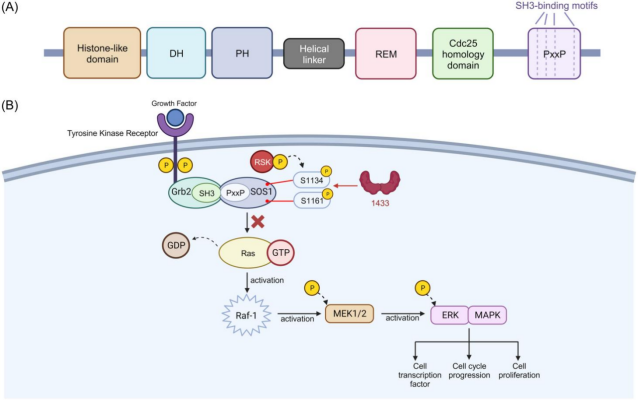
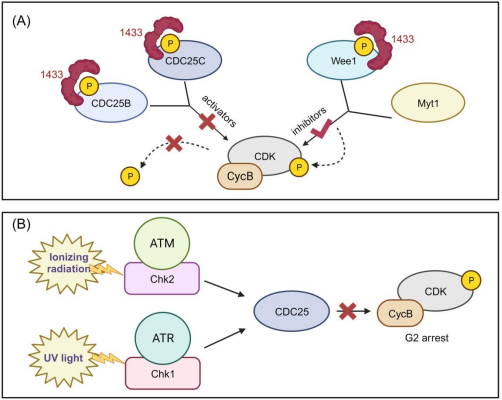
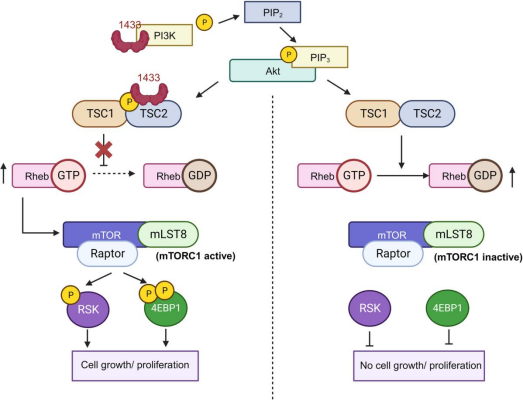
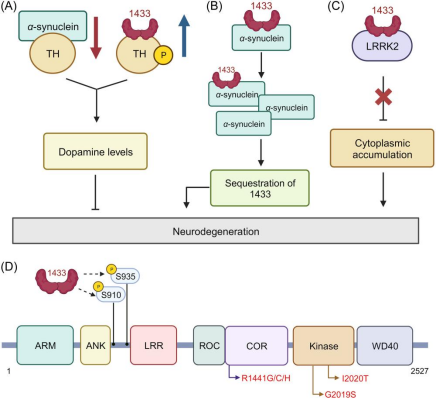
Die Familie der 14-3-3-Proteine sind hochkonservierte, saure eukaryotische Proteine (25–32 kDa), die im Körper reichlich vorkommen [1]. Bei Säugetieren gibt es sieben verschiedene Isoformen von 14-3-3-Proteinen, nämlich α/β, σ, θ, γ, ε, η und ζ/δ. Jede dieser Isoformen bindet durch Phosphorylierung an mehrere hundert unterschiedliche Proteine. Es wurde festgestellt, dass sie ein breites Spektrum zellulärer Prozesse moduliert, wie Zellsignalisierung, Transkription, Zelldifferenzierung, Zelltod (Apoptose), Proteintransport, angeborene Immunität und Glukosestoffwechsel, um nur einige zu nennen [2]. Eine Dysregulation dieser Proteine wurde mit dem Ausbruch schwerwiegender Erkrankungen wie Krebs, neurodegenerativen Erkrankungen und viralen Infektionen in Verbindung gebracht [3].
| Catalog# | Produktname | Reaktivität | Anwendung |
|---|---|---|---|
| AMRe01592 | 14-3-3 Kaninchen Monoklonaler Antikörper | Mensch,Hund,Maus,Ratte | WB |
| AMRe06275 | 14-3-3 gamma (13M6) Kaninchen Monoklonaler Antikörper | Mensch,Hund,Maus,Ratte | WB |
| APRab06283 | 14-3-3 ζ/δ Kaninchen Polyklonaler Antikörper | Mensch,Hund,Maus,Ratte | WB,IHC-P,IF-P,IF-F,ICC/IF,ELISA |
| AMRe06274 | 14-3-3 epsilon (1W4) Kaninchen Monoklonaler Antikörper | Mensch,Hund,Maus,Ratte | WB,ICC/IF,FC |
| AMRe01593 | 14-3-3 theta Kaninchen Monoklonaler Antikörper | Mensch,Hund,Maus,Ratte | WB |
| APRab06284 | 14-3-3 η Kaninchen Polyklonaler Antikörper | Mensch,Hund,Maus,Ratte | WB,IHC-P,IF-P,IF-F,ICC/IF,ELISA |
| APS0635 | HRP-konjugierter Polyklonaler Anti-Kaninchen IgG(H+L) Sekundärantikörper | Kaninchen | ELISA,WB,Dot blot |
| AMre80004 | GAPDH (12R9) Kaninchen Monoklonaler Antikörper | Mensch,Hund,Maus,Kaninchen,Hund,Schwein | WB,ELISA |
Verwandte Produkte
Super-sensitives ECL-Chemilumineszenz-Reagenz
Referenzen
- Low ZY, Yip AJW, Chan AML, Choo WS. 14-3-3 Family of Proteins: Biological Implications, Molecular Interactions, and Potential Intervention in Cancer, Virus and Neurodegeneration Disorders. J Cell Biochem. 2024 Jul;125(7):e30624. Epub 2024 Jun 30. [PMID: 38946063].
- Nathan KG, Lal SK. The Multifarious Role of 14-3-3 Family of Proteins in Viral Replication. Viruses. 2020 Apr 13;12(4):436. [PMID: 32294919].
- Obsilova V, Obsil T. Structural insights into the functional roles of 14-3-3 proteins. Front Mol Biosci. 2022 Sep 16;9:1016071. 2022.1016071. [PMID: 36188227]
- Gardino AK, Yaffe MB. 14-3-3 proteins as signaling integration points for cell cycle control and apoptosis. Semin Cell Dev Biol. 2011 Sep;22(7):688-95. Epub 2011 Sep 14. [PMID: 2194564].
- Zou Z, Tao T, Li H, Zhu X. mTOR signaling pathway and mTOR inhibitors in cancer: progress and challenges. Cell Biosci. 2020 Mar 10;10:31. [PMID: 32175074].
- Shimada T, Fournier AE, Yamagata K. Neuroprotective function of 14-3-3 proteins in neurodegeneration. Biomed Res Int. 2013;2013:564534. Epub 2013 Dec 2. [PMID: 24364034].